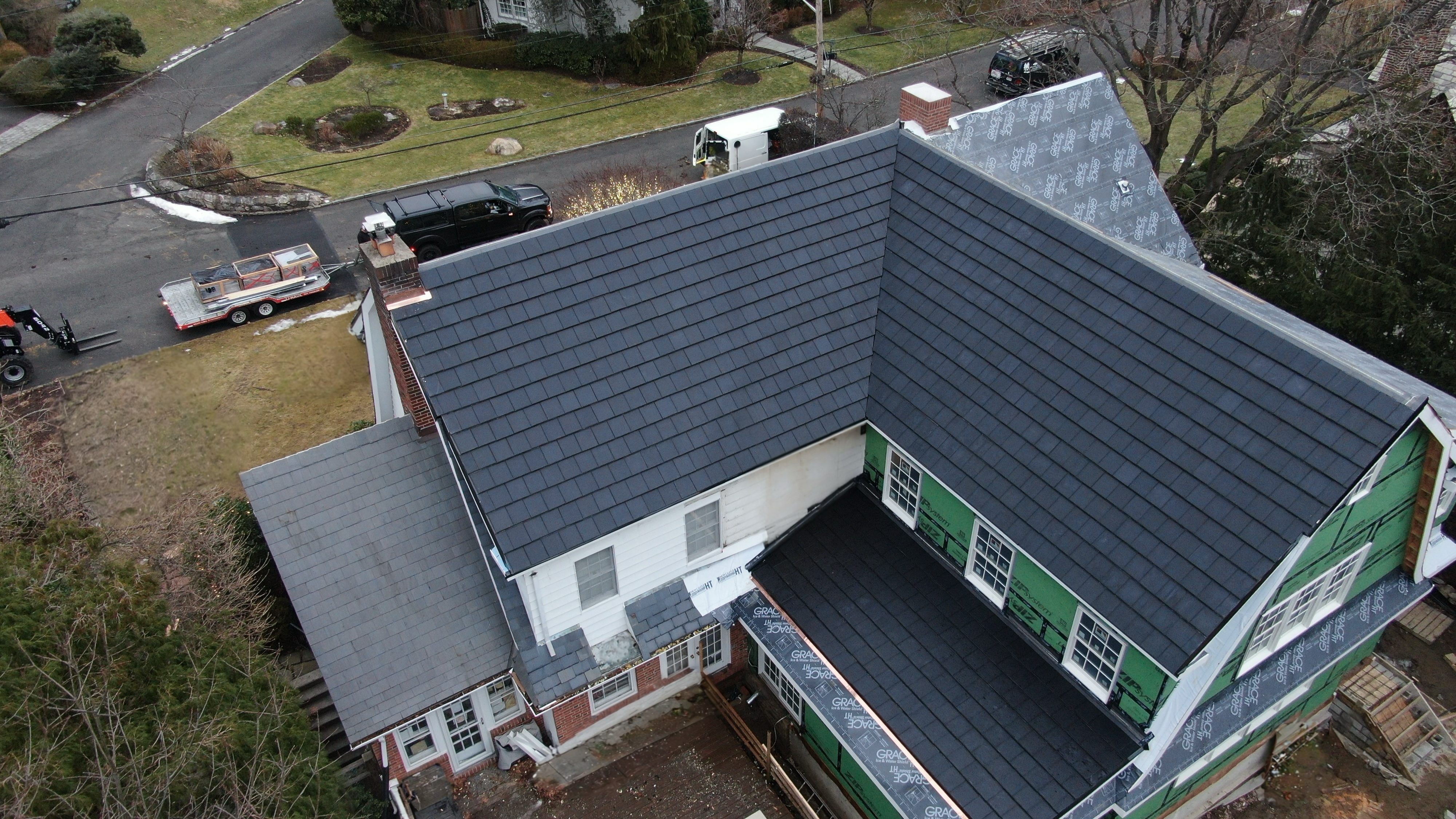
Tesla stopped taking new Solar Roof orders on August 20, 2026. If you spent years watching that category, waiting on a quote, or walking away from it, the roof you actually wanted still exists. It is available now, not on a waitlist.
Sternholt designs and manages Voltaic ICON concrete solar roof tile installations across New York, New Jersey, Connecticut, and Pennsylvania. Invisible Solar Power. A roof, not a display of technology.
Start the conversationConcrete tile roofing, not glass. Class A fire rated. Wind tested to 180 mph. Thirty year roof warranty, twenty five year power warranty, ten year product warranty. One firm managing design, engineering, and installation, working with licensed roofing and electrical contractors on every project.
See how the investment comparesWhat Happened to the Tesla Solar Roof
On August 20, 2026, Tesla told its certified installers that Solar Roof tiles were no longer available to order. Tesla has not issued a formal announcement, but the change was confirmed independently by Electrek and several other outlets, and tesla.com/solarroof now redirects to Tesla's conventional solar panel page. One source close to the program told Electrek that Tesla had internally concluded the product was not financially viable after nearly a decade and roughly three thousand installations nationwide. Homeowners with an existing Tesla Solar Roof keep their warranty coverage. The change affects new orders only.
For the homeowners who spent years watching this category, the news was less a surprise than a confirmation of what the last few years already suggested.
What Tesla Got Right
Before the failure, it is worth naming what Tesla understood correctly, because the underlying idea was never the problem.
There is a large and underserved group of homeowners who want to generate solar energy but will not mount panels on their roof, not out of indifference to sustainability or cost, but because the visual compromise is unacceptable on a home that has been designed and maintained with care. When Elon Musk unveiled the Solar Roof in 2016, he was speaking directly to that homeowner, promising a roof that generates electricity and still looks like it was always meant to look that way. The concept was correct. The market was real. The execution is where it fell apart.
Where It Went Wrong
The installation timeline was the first failure. Homeowners who signed contracts in 2019 and 2020 routinely waited two to three years for their projects to begin, since Tesla's manufacturing and installation capacity never caught up with demand.
The pricing was the second failure. By the time a project reached installation, the final cost had often increased twenty to forty percent over the original quote, leaving homeowners who budgeted carefully facing a very different financial picture with little recourse.
The product itself was the third failure. The glass tile used in the Solar Roof photographed well but read as distinctly technological up close, with visible seam lines and reflectivity. For a homeowner whose entire reason for choosing the product was to avoid looking like they had solar, that was a fundamental contradiction.
These three failures compounded. A significant share of customers who signed contracts never saw their projects completed, and the category Tesla created, architecturally integrated solar roofing for serious homes, went largely unfulfilled despite real demand. Discontinuation in August 2026 was the conclusion of that trajectory, not a surprise turn.
The Gap It Leaves Behind
The remarkable part of the Tesla Solar Roof story was never the failure itself. It is the size of the gap it leaves behind. The market of homeowners who want a roof that generates electricity without looking like it does did not disappear when Tesla struggled, and it does not disappear now that ordering has stopped. Those homeowners still need roofs. They still pay utility bills. They still care about how their home looks. They are still looking for the thing that was promised to them.
What Replaces It
The category Tesla popularized has matured past it. The most significant advancement is the concrete solar roof tile, cast the same way concrete roofing tiles have been cast for generations, with the solar cell integrated directly into the material during manufacturing, not layered onto glass or a thin film substrate.
In practice, this means a roof that looks like a premium concrete tile roof from the street, from a car passing by, from an aerial view, from every architectural vantage point. The solar generation is invisible not because it is hidden, but because it is built into the material itself. The tile is the roof. There is no visible technology sitting on top of it.
This is a different proposition than anything Tesla built. It is not a glass product trying to approximate roofing material. It is a roofing material that generates electricity, and that distinction carries through aesthetics, aging, performance, and how the roof integrates with the rest of a serious home.
What This Means for You Now
There is no longer a Tesla option to wait for. The product that Tesla described in 2016, a roof that generates solar energy without looking like it does, exists today in a form that actually delivers on that description, and it is available now rather than on a multi year backlog.
The aesthetics are different in the ways that matter. A concrete tile profile looks like premium roofing because it is premium roofing. If the Tesla product read as technology rather than architecture, that concern does not apply here.
The project is managed by specialists in this material specifically, not a company learning construction as it goes. Sternholt designs, engineers, and manages every Voltaic ICON project from first conversation through completion, working with licensed roofing and electrical contractors on execution.
Sternholt is the design and project management firm for the Voltaic ICON concrete solar roof tile across New York, New Jersey, Connecticut, and Pennsylvania. We work with a limited number of homeowners each year whose homes and standards align with what this material requires.