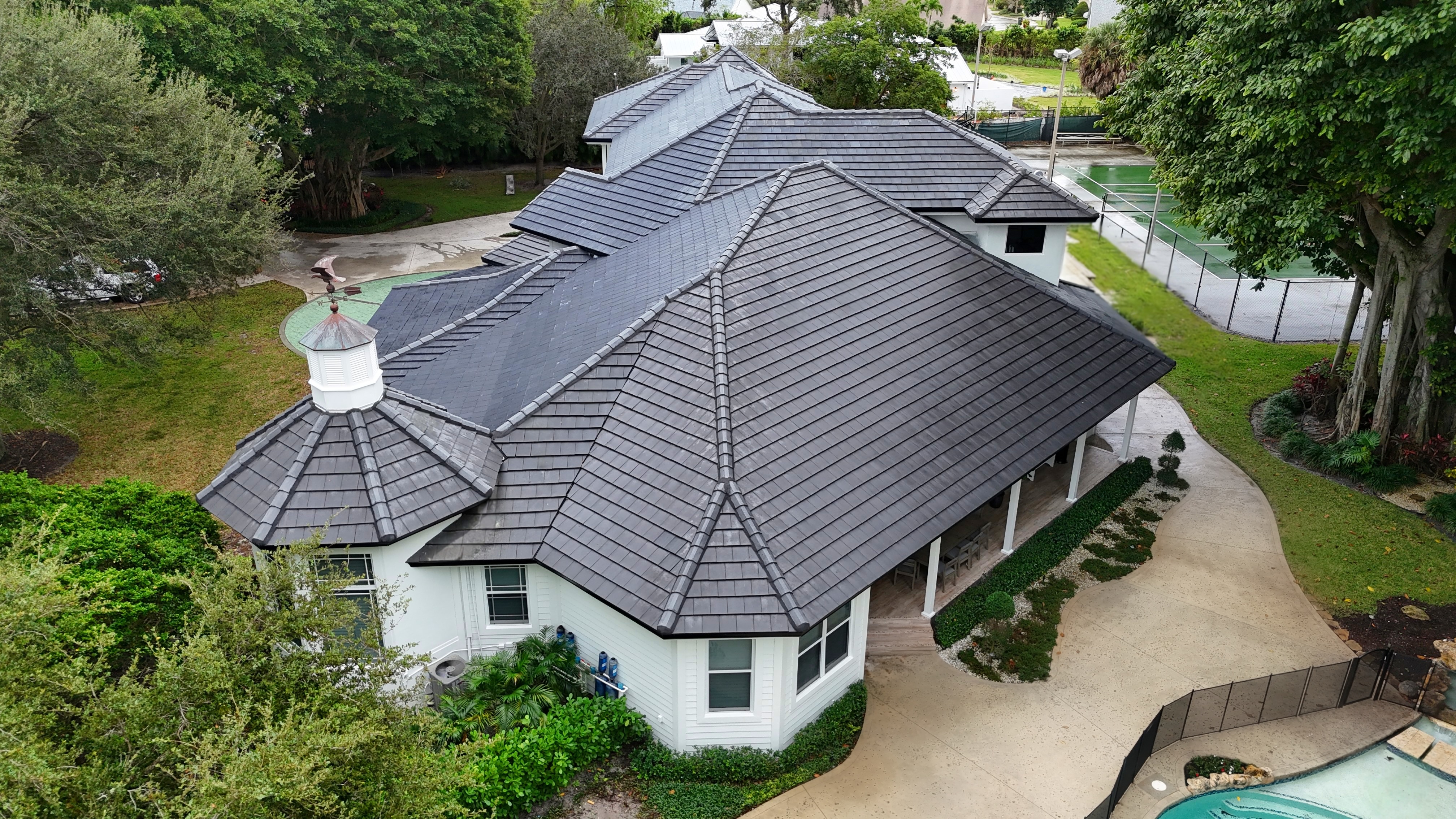
There is a particular kind of homeowner who approaches every decision about their property with the same standard. The kitchen gets the same attention as the library. The landscaping gets the same attention as the foyer. Nothing is treated as a default, and nothing is chosen simply because it is what everyone else does.
And then there is the roof.
For reasons that are more habit than logic, the roof has historically been treated as a commodity decision even among homeowners who would never approach any other surface that way. You call a contractor, you pick from a handful of materials, you sign off on something that will define the look of your home for the next several decades, and you move on. The process takes less thought than selecting a faucet finish.
This is beginning to change. And for a specific type of homeowner, it is changing in a meaningful way.
The Roof Is Not a Maintenance Item
The most visible surface of any home is not the front door or the windows or the stonework on the exterior. It is the roof. From the street, from a car passing by, from an aerial view, the roof defines the silhouette and character of the structure more than any other single element.
Architects have always understood this. In the design of serious homes, the roofline is one of the first decisions made, not one of the last. The pitch, the material, the color, the texture — these are design decisions with consequences that last the life of the building.
Yet somewhere between the architect's drawing and the contractor's quote, the roof often gets reduced to a line item. The premium gets stripped out in favor of something faster, cheaper, and more familiar. The result is a home where everything inside reflects the owner's taste and the roof looks like it belongs on a different house entirely.
The homeowners who are rethinking this are not doing so because of a trend. They are doing so because the standard never made sense to them in the first place.
What Premium Roofing Actually Means
When we talk about premium roofing materials, we are talking about a small category of options that have defined serious residential architecture for centuries. Natural slate. Spanish clay tile. Standing seam metal. These materials share a common quality. They are chosen not because they are practical but because they are right — because the homeowner making the decision understood that the roof deserved the same intention as everything else.
These materials age in ways that only improve them. They do not fade, warp, or lose their character over time. A slate roof installed correctly on a home in New England in 1920 may still be performing today. They are not chosen for their payback period. They are chosen because a serious home deserves a serious material.
A New Category Has Entered the Conversation
Within the last several years, a new material has emerged that belongs in the same conversation as slate, clay tile, and standing seam metal. It is a concrete solar roof tile, and it is unlike anything that came before it in one specific way.
It generates electricity. Invisibly, permanently, and without any visible indication that it does so.
There are no panels. There is no rack system mounted above the roof surface. There is no visible technology of any kind. The solar cell is integrated directly into the concrete tile during manufacturing. The tile is the roof. What you see from the street, from above, from any vantage point, is a beautifully designed roof surface and nothing else.
This is not the solar roof of popular imagination. It is not the product that requires a homeowner to choose between aesthetics and energy production. It is the product that finally removes that choice entirely.
Why This Matters for the Homeowner Who Refused to Compromise
There is a specific homeowner who has been waiting for this without knowing it existed.
They own a serious home. They care deeply about how it looks. They have watched the conversation around residential solar energy evolve over the years and found themselves perpetually uninterested because the visual compromise was never acceptable to them. Panels on a roof, regardless of how they are marketed, change the character of a roofline in a way that a certain type of homeowner simply will not accept.
These are not people who are indifferent to sustainability or energy independence. Many of them are deeply interested in both. They simply refused to pursue those things at the expense of a home they have spent years and significant resources getting right.
For this homeowner, the integrated concrete solar tile is not a solar product. It is a roofing material that happens to generate electricity. The distinction matters enormously.
The Decision That Lasts the Life of the Building
Every serious roofing decision shares one characteristic that separates it from most other home improvement decisions. It is essentially permanent.
You do not replace a slate roof every fifteen years. You do not revisit a clay tile installation because you grew tired of it. When a homeowner with a serious property makes a serious roofing decision, they are making it once. The material they choose will define the look of their home for the rest of the time they own it and likely beyond.
The homeowners who are rethinking what a roof can be are not doing so frivolously. They are doing so because they understand that this decision, more than almost any other they will make about their property, deserves to be made with intention.
Sternholt is the design and project management firm for architecturally integrated solar roof tiles across New York, New Jersey, Connecticut, and Pennsylvania. We work with a limited number of homeowners each year whose properties and standards align with what this material requires and deserves.